Blog and Helpful Articles

What We’re Reading – Amazon Partners on Employee Primary Care Centers Near Fulfillment Centers

Amazon announced a pilot program to provide accessible primary care services to its employees by opening 20 Neighborhood Health Centers in cities across the US.  In this article, the author explains that Amazon’s employee benefits program provides comprehensive health care beginning on the first day of employment and hints at the need for flexible care options given the large number of employees and varied work schedules.

Amazon has approximately 175 fulfillment and operations centers across the country and as of April 30th, Geekwire reports Amazon has 935,000 full-and part-time employees. If the pilot is successful, Amazon will expand the number of facilities accordingly. Access to care has many components; close proximity and extended hours are two important factors that seem to be addressed by the Neighborhood Health Center program.

Read Full Post | Comments Off on What We’re Reading – Amazon Partners on Employee Primary Care Centers Near Fulfillment Centers

Tagged , , |

Did You Know… Medicare Pays for Counseling for Smoking Cessation

A staggering amount of research shows the detrimental effects smoking can have on a person’s health, and public service announcements abound on this topic.  Some providers may not know that Medicare is also on this bandwagon and pays for PCPs to counsel their smoker patients to quit.  During the public health emergency, counseling can be delivered by telehealth, telephone only.

Two counseling attempts per year are covered so providers can screen patients for continued smoking, and if appropriate, utilize the 5As approach to counsel them on quitting. Up to four sessions are allowed for each smoking cessation attempt, which means that PCPs can deliver up to eight sessions in a year.

As a reminder, the 5As is a behavioral counseling intervention that has been adopted by the USPSTF and includes: Assessing, Advising, Agreeing, Assisting and Arranging.  What derails some cessation counseling efforts is not spending enough time building agreement before moving to assisting, such as recommending medications, etc.

Feel free to request our free bulletin on billing this service and be sure to check with commercial payors to see if they also cover counseling for smoking cessation.

Read Full Post | Comments Off on Did You Know… Medicare Pays for Counseling for Smoking Cessation

Tagged , , , , |

Did You Know… Medicare Pays for Counseling for Obesity & CVD?

Intensive Behavioral Therapy (IBT) is a series of counseling sessions aimed at reducing the risk of cardiovascular disease (CVD), which can lead to heart attack or stroke. It is also used for helping patients make behavioral changes that facilitate weight loss through proper diet and exercise. CMS covers IBT as follows:

For CVD: One annual, individual face-to-face (F2F) 15-minute IBT counseling session for CVD conducted by the PCP or non-physician primary care practitioner.  The session should include, as appropriate:  encouraging ASA use, BP screening and dietary counseling.

For Obesity (patients with a BMI of 30+): a series of sessions centering around weight loss and healthier lifestyle choices.  The number of covered sessions depends on whether the patient loses at least 6.6 lbs in six months or not.

The behavioral counseling intervention should be consistent with the Five As approach that has been adopted by the USPSTF:

  • Assess
  • Advise
  • Agree
  • Assist
  • Arrange

IBT is covered once per year for CVD and for obesity, CMS can cover up to 20 counseling visits per year depending on the patient’s weight loss.    Feel free to request our free bulletin on billing this service and be sure to check with commercial payors to see if they also cover counseling for CVD risk and/or obesity.

Read Full Post | Comments Off on Did You Know… Medicare Pays for Counseling for Obesity & CVD?

Tagged , , , , , , |

Why Is July Relevant for MRA?

Risk adjusted reimbursement is based on the health status of the patient as summarized by certain ICD-10-CM codes reported by the provider.  The reporting timeframe is twice per year in order to maintain stable funding; PCPs should assess, document and code to the highest level of specificity all of the patient’s chronic conditions in visits between January 1st and June 30th and again between July 1st and December 31st.  We always recommend, where possible, to assess and report all the MRA conditions in the first visit of the period; this allows providers to focus on the chief complaint on subsequent visits along with any chronic conditions that are relevant.

Since we have now entered the second semester of the year, we are reminding all providers to assess all of the patient’s risk adjusted or MRA conditions with – what we call – bulletproof documentation.  CCG has two recent blogs on this topic: General documentation tips can be found here and E/M Services are explained here.

Remember that MRA conditions require a face-to-face visit, or in the this New Normal of COVID, where patients may be reluctant to come to the office, a telehealth visit with audio AND video. Proper documentation of telehealth is covered in this blog.

Read Full Post | Comments Off on Why Is July Relevant for MRA?

Tagged , , |

Wanna Bet Not All Your MDDs Are Valid?

Major Depressive Disorder (MDD) is fast becoming one of the most poorly supported conditions we find during audits, and it may stem from the fuzzily documented distinction between depression and major depression.  After all, not all depression fits in the major category, and the Patient Health Questionnaire (PHQ-9), often used to document the patient’s symptoms, is not always interpreted correctly.

The PHQ-9 contains nine symptoms with various frequencies from ‘not at all’ to ‘nearly every day.’  The form itself contains a scoring mechanism that translates the total score to a category of depression (minimal, mild, moderate, moderately severe and severe).  However, the criteria and their frequency don’t fully correlate to the MDD criteria promulgated by the Diagnostic and Statistical Manual of Mental Disorders, 5th Edition (DSM-5) of the American Psychiatric Association.

The diagnosis of MDD is for patients who suffer nearly every day from specific symptoms for at least a two-week period.  These symptoms include depressed mood most of the day; markedly diminished interest or pleasure in activities most of the day; significant weight loss when not dieting, weight gain or changes in appetite; insomnia or hypersomnia; psychomotor agitation or retardation; fatigue or loss of energy; feelings of worthlessness or excessive guilt; diminished ability to think or concentrate; and/or recurrent thoughts of death or suicide ideation/attempt.  Feel free to request our Bulletin on Major Depressive Disorder and also watch this short video.

The major problem in translating the PHQ-9 to an MDD diagnosis is the qualifiers from the DSM.  Each criterion has additional requirements and the most significant is that five criteria must be present nearly every day.

In the last three years of audits of MDD, we have found more than 90% do not meet the criteria for the disorder.  This doesn’t mean these patients are not or were not depressed; it just means the documentation did not support they were majorly depressed in accordance with the specific requirements of the disorder.  The use of antidepressants is also not evidence of MDD, as patients with depression are treated with the same medications.

The final error in MDD coding and documentation is failing to apply the concept of episodes.  MDD occurs in episodes (e.g., initial, recurrent), which are tied to meeting the five criteria.  Once the patient’s symptoms diminish or disappear, the patient can be considered in partial or complete remission until the next episode.

This largely unsupported and erroneously coded condition is removed during an audit from patient diagnostic profiles if the evidence is not well charted.  Call us for a free, no-obligation consultation to discuss MDD – or other risk adjusted conditions – in your practice.

Read Full Post | Comments Off on Wanna Bet Not All Your MDDs Are Valid?

Tagged , , , , , , |

What We’re Reading – Overcoming Telehealth Reimbursement Risks

The advantageous use of technology to successfully treat and manage patients in a world that restricts physical consults to prevent the spread of the virus has served both patients and physicians.

However, as explained in this article, telehealth’s quick implementation hasn’t allowed much time for medical practices to catch up with all the requirements for payment and billing from Medicare and other payers.  Just like Covid-19, telehealth is relatively new territory for the medical community. Therefore, physicians should be mindful of the possibility of future audits and take measures to ensure proper documentation of telehealth encounters as outlined in this article we read.

The author explains that healthcare providers have little experience with claims denials for the recently expanded telehealth services and this has led them to be detailed in their documentation.  To decrease the likelihood of claim denial, providers need to document “date, time and place of service, length of the conversation, emergency room or outpatient consultations, provider recommendations, and follow-up visits.”

Also, the technological vehicle used to do the consultation, whether audio and/or video, and the patient’s consent to use apps that don’t have privacy protection, such as Skype, needs to be specified in the progress note.

The article also contains some good practices for telehealth reimbursement compliance: continuously monitoring and auditing telehealth claims, staying current on government and private payers’ developing guidelines, redirecting employees’ efforts to ensure billing compliance, and training coders.

Telehealth services are likely to be around for the long run.  As medical practices continue to send claims to their payers, guidelines will be perfected to generate proper reimbursement based on medical necessity and the complexity of the physician-patient encounter.

Read Full Post | Comments Off on What We’re Reading – Overcoming Telehealth Reimbursement Risks

Tagged , , , , , |

Reminders for Proper Documentation

We all know providers are stressed for time and want to provide the best medical care to each and every one of their patients even in a short window of time. Unfortunately, the first thing to suffer is the documentation aspect of the visit. We’ve heard it before: “If it’s not documented, it didn’t happen.”

When we perform audits for our clients, the most common documentation errors we find are:

  • Cloned notes.  In this phenomenon, we discover that each progress note looks the same as the prior visit’s note, and the only thing that has changed is the patient’s vital signs.   Cloned notes occur because most EMRs allow for copying/pasting or providers rely on click-boxes and templates. Cloned notes raise flags for regulators who then question the validity of other things on the progress note.
  • Contradictions.  The SOAP sections of the progress note should flow cohesively with each section contributing to the selection of diagnoses being assessed. When the exams (ROS/PE) don’t match what is documented in the assessment/plan, the resulting conditions must be questioned and cannot be coded (e.g., ROS says the patient denies numbness/tingling in the extremities, but the plan says, “Patient is experiencing/exhibiting numbness and tingling, and has neuropathy).
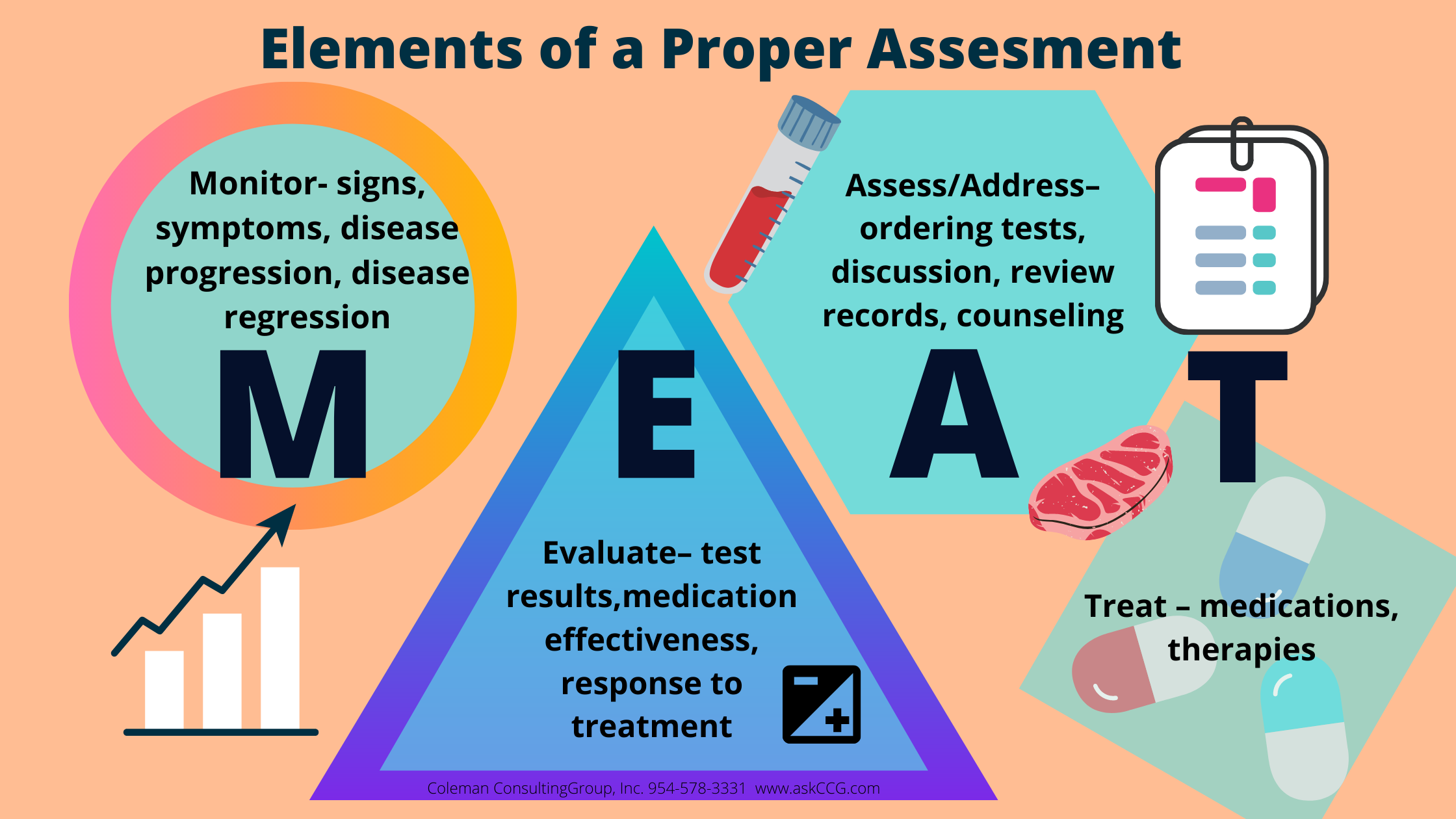
  • No assessment of condition.  The assessment must convey the status of the condition, how the patient is responding to treatment, and how the provider is managing the diagnosis.  Simply ordering a test or refilling medications is not a sufficient assessment of a medical condition.  Download our graphic to remind you of the proper elements of an assessment.
  • Template verbiage.  EMRs are a great tool in the medical practice but for every advantage, we can identify a concern.  The convenience of pre-programmed templated language, such as “Stable, will continue to monitor” says very little about the condition and may prompt an auditor to disallow the condition because it wasn’t properly assessed.  Read our blog on the Joys & Perils of Templates.
  • Combination codes. ICD-10-CM created some welcome shortcuts where two linked conditions are reported with only one code. However, both conditions must be assessed.  When, for example, Type 2 Diabetes Mellitus w/ polyneuropathy (E11.42) is reported, the provider must assess the diabetes and the polyneuropathy. If only one is assessed, the code cannot be validated.

The progress note is a legal medical document and from an auditing standpoint, each one needs to stand alone and tell a story of the patient’s conditions. It’s important to consider that the usual PCP may not always be the one to see the patient and anyone who reviews the note should be able to quickly pick up the details of the patient’s care.

Read Full Post | Comments Off on Reminders for Proper Documentation

Tagged , , , , , , |

Coding E/M Services – Part 2

Welcome back to our two-part series on Coding E/M Services.  As we covered in part one of this series, the level of E/M service determines the payment for the visit an there are seven components that factor into the E/M Service.  The first three we reviewed are the chief complaint, history and examination.  Below are the other four.

Medical decision-making (MDM) is probably one of the trickiest to gauge because it is based on the number and types of medical problems addressed, the complexity of establishing a diagnosis and the decisions made by the clinician in the management of the conditions.  MDM ranges from straight-forward to complex (low, moderate or high), and each of these requires meeting certain criteria explained in the E/M codes’ documentation guidelines. It is a critical mistake to believe that listing all or many of the patient’s chronic diagnoses – in what we refer to as a laundry list – is sufficient to support highly complex MDM; it does not.  The MDM stems from the complete history, exam and assessment of all of those conditions as documented in the note. That’s the tricky part because it requires synthesizing onto the screen (or page??) all the relevant considerations in the mind of the clinician when evaluating the patient.

Counseling and coordination of care are usually reported in the same areas of the progress note. In these sections, the provider summarizes the next treatment steps for the patient’s conditions and explains the counseling (or instructions) given to the patient.  Many providers rely on templated language (a topic explored in this blog) for counseling on diet, exercise and other lifestyle habits and/or list handouts given to the patient on specific diseases. Not only do these activities barely scratch the surface in this regard (as we will see in the last component of the E/M service) but they sometimes contain phrases that are not true for the patient.

Time is the last element that may affect selection and support of an E/M code.  If more than 50% of the visit involves counseling and/or coordination of care, the amount of time spent in these activities could justify a higher code level.  However, keep in mind that illness complexity does not drive the time factor.  The keys to taking advantage of the time element are:  the time spent in counseling must be listed on the note and the documentation must explain the counseling given to the patient, not just providing a handout.

Templated language makes it easy for providers to document “counseling.”  If the information isn’t completely verbalized to the patient, some prevailing considerations might be that the patient will receive a copy of the visit note and thereby “be counseled.”  We strongly caution clients against that approach.  An interesting study we summarized from JAMA revealed that more than 20% of patients found errors in their medical notes, and some specifically cited areas, such as counseling, that were documented by the clinician but were not performed.

Fortunately, many providers employ coders in their practices who can review the documentation and make sure the selected codes are correct, while others may outsource their coding to a firm specializing in this area.  A mechanism for provider education and feedback is important in order to minimize future errors in E/M coding since let’s face it, clinicians are now forced to wear a coder’s hat but haven’t really been educated on the nuances of proper coding.  If you would like to explore outsourcing your practice’s coding, or would like education for your clinical or coding team, please contact us.

Read Full Post | Comments Off on Coding E/M Services – Part 2

Tagged , , , , |

The Joys & Perils of Templates

Most of us will jump at the chance to find an easier way to accomplish the same result.  I mean, who doesn’t love shortcuts?!  Electronic medical records (EMRs) are probably one of the biggest time-savers for a medical practice.  The days of running around the office looking for a “lost” chart are gone.  Multiple team members can access a patient’s chart – even remotely – without needing to coordinate logistics of whose request takes priority.  Information is more easily retrievable, as long as it has been properly filed and labeled in a sectioned chart.  Typing might even be easier for most of us whose handwriting resembles hieroglyphics – to the appreciation of pharmacists and medical staff!

The remote aspect deserves its own paragraph as the Internet and remote access allow a provider on call to view the patient’s chart during an after-hours call.  Or transmit a prescription to the pharmacy at 2 AM.  Not to mention the ability to use a tablet or even a smartphone to review lab results and other diagnostics, write an order or chip away at the “decreased” workload of electronic documents.

Documenting the encounter also has benefits in the world of EMRs.  There is almost no end to the creation of specific progress note templates that touch on a clinician’s required elements of a visit or diagnosis.  Do you want your staff to ask specific questions at every visit?  Make a template.  Want to assess a patient’s risk status for a certain condition? Make a template.  Want to require your clinicians to evaluate certain systems on all diabetic visits, make a template!  Want to save your wrists from having to type free-hand all the assessment language (e.g., stable, controlled, continue on [med name], counseling), use a template, and save yourself some time.

Sounds idyllic.  But here’s the downside.

An assessment of primary care physician workload in the Annals of Family Medicine revealed that providers spent almost six hours of an 11.4 hour-day workday in the EMR, of which slightly more than the 44% of time was devoted to administrative tasks, such as documentation, order entry, billing and coding.  The survey concluded that – for all their benefits, and we really just scratched the surface – digital records increase the burden on physicians and reduce their degree of attentiveness to the patient. (Click here to read about how EMRs contribute to physician burnout.)

Structured data templates and checkboxes negatively automatize and generalize the interrogatory and management process in a patient encounter. By heavily standardizing the medical documentation clinicians might miss essential details in the patient’s history, which could affect their ability to a more rapid and accurate diagnosis. Additionally, the extensive and organized progress notes often fail to offer a real picture of the actual episode of care. Even when there is more manual input from the physician, the documentation is often plagued with inconsistencies and contradictory clinical findings. (Click here to read more about a JAMA study that found more than 20% errors in EMR progress notes.)

Overuse and misuse of templates can have a negative financial impact by making medical practices subject to audits and corrective action plans. Duplicated and vague documentation are red flags to the Centers for Medicare and Medicaid Services (CMS). Although CMS guidelines don’t forbid the use of EMR templates, their Medicare Program Integrity Manual discourages the use of templates that are mainly based on checkboxes and predetermined answers since these sometimes limit the provider from documenting all the necessary facts to meet the medical necessity requirement for billing purposes.

Read Full Post | Comments Off on The Joys & Perils of Templates

Tagged , , , |

F2F or Virtual Education – Which is Right for You?

Organizations and venues that rely on conventions, conferences and sizable meetings are hard-hit because of the COVID-19 crisis and the jury is out on how well these activities will bounce back from the shut-downs.  Zoom meetings seem to have become the rage and the company’s stock has doubled in price during the pandemic. For all the advantages of teleconferencing and videoconferencing, their use for education can have considerable limitations.

There is absolutely no way for a virtual learning experience to replicate the dynamic that occurs in a face-to-face (F2F) environment.  F2F seminars offer a different level of engagement with the topic, instructor and colleagues that is absent when sitting in front of a screen, fairly invisible.  Am I the only one who usually multi-tasks during webinars?

To be successful, coding education requires interaction.  One-on-one education isn’t always feasible or cost-effective, and we can’t ignore the learning that occurs in group settings when participants ask questions or make comments.  In fact, a 2010 study on virtual meetings briefly mentioned the barriers participants encounter when trying to signal their intention to speak or interrupt the current discussion.  This can short-circuit the learning objectives.

However, given the reluctance of many clients to host or participate in F2F meetings, below are some of the guidelines we recently implemented in a medium-sized F2F meeting, which may reassure clients of the safety of group attendance.

  • Scaled the attendance list to the size of the venue. This can necessitate breaking groups into smaller subgroups and conducting more sessions than planned, but we believe this is a reasonable accommodation in light of social distancing.
  • Another key to lower-stress F2F gatherings was arranging the seating with social distancing in mind. In large venues, it’s possible to seat one person per table, or to spread the chairs out to minimize close contact.
  • Disinfecting all surfaces is always important. Regardless of the venue’s cleaning practices, we regularly wiped down all surfaces with disinfectant, especially tables and chairs.
  • Individually-packaged refreshments are nothing new but the manner in which they are arranged and displayed can go a long way toward reassuring guests that they have been handled in a manner that maximizes safety.
  • We prepared and distributed educational materials in the safest manner possible. Laminated tools were disinfected with alcohol wipes, carefully stored and distributed by gloved hands.
  • All attendees were expected to wear face masks in accordance with CDC guidelines, and presenters wore masks or face shields while distancing themselves from participants.
  • The last key to lower-stress F2F gatherings is communication: we let each group of attendees know the measures taken to preserve their safety and encouraged them to speak up about any suggestions to improve on these best practices.

Read Full Post | Comments Off on F2F or Virtual Education – Which is Right for You?

Tagged , , , |