Blog and Helpful Articles

“Not-Assessments:” Misconceptions about Assessing Conditions
We educate a good bit about documentation of a proper assessment, use the acronyms M-E-A-T or T-E-A-M and still see skimpy notes with an “assessment” that doesn’t pass muster – from providers who, by now, should be on board with the concept. It occurred to us that maybe they don’t understand what is meant by the term or are unclear that their charting doesn’t meet the standard.

The Cambridge Dictionary online defines assessment as “the process of considering all the information about a situation or a person, and making a judgement.”  Applying this definition to medical documentation, we know that clinicians obviously do make assessments of a patient’s medical conditions, but that thought process is not usually reflected in any detail on the progress note.  And therein lies the biggest issue:  synthesizing your split-second thoughts into a short but meaningful “blurb” about each medical problem.

Let’s begin with what is not an assessment of a medical condition.

Refilling medications.  Although some would argue that a medication refill shows the condition is being managed, it’s not enough.  After all, medication refills can be accomplished without a visit on that day.  In some practices, med refills are independently transacted by staff within narrow parameters from the primary care practitioner (PCP).  But ultimately, simply refilling a prescription doesn’t say a word about the thoughts leading up to the judgment to refill.  A provider might argue that in the case of a diabetic medication refill, one (meaning a coder or regulator) should look at the embedded labs in the note to determine that the patient’s blood sugar is at the treatment goal, thus, no change in medication is warranted, and that this very string of thoughts occurred to the clinician which is why the medication was refilled – ergo, the condition was assessed.  Sorry, but no.  The provider should write something along the lines of, “A1c is at goal of under 6.5 and patient reports fasting sugars under 100.  Continue current treatment plan. Refill XYZ.”

Ordering tests.  This one is similar to refilling medications and the same thought process applies.  Coders and auditors cannot infer from a test order that the condition has been assessed.  Consequently, a description of the status of the condition, treatment goals and instructions given to the patient can fill in the blanks of the visit.  After all, we know the PCP discussed something with the patient!  Document a summary of that discussion: “Patient reports poor adherence to dietary plan and has been eating more fatty foods than usual.  She will have a new lipid panel today and we’ll discuss medication and dietary issues at the next visit.”

Referral to, or management by, a specialist.  Let’s consider the referral first.  Proper documentation would require verbiage showing why the patient is being referred for this particular condition and what the specialist is expected to do.  Put on your payor hat:  providers are paid for doing something with the condition.  If the treatment aspect is being transferred to another provider, why would a payor accept this diagnosis as part of the basis for a PCP’s payment (either FFS or capitated)?  One could argue that in the capitated/risk adjusted payment world, a referral is part of “management” but the rationale is still missing. What did the PCP see or think on this day to prompt the referral? That’s what should be documented on the visit note!

If the condition is being managed by the specialist, as occurs with conditions like diabetic retinopathy, what assessment is the PCP making? Many of our clients raise the issue that they are not equipped to assess the patient’s retinopathy and we understand that. However, we assume the PCP receives consultation reports from the specialist; a blurb about the last consult, the treatment the patient is receiving from the specialist, any worsening of visual issues, reminders about tighter blood sugar control and/or explanations about the specialist’s role in treating the condition at least show the PCP’s management.  Absent that, it’s best to issue the referral and not include the condition in the assessment since it hasn’t really been assessed.

Perhaps by looking at these three “not” assessments, providers will begin to understand the type of information expected for each medical condition on a progress note.  Whether you remember M-E-A-T or T-E-A-M, each condition must have documented evidence of how the PCP is Managing, Evaluating, Addressing and Treating it.  Don’t be like one provider many years ago, who asked, “You mean I have to assess every condition I list under the Assessment section of the note??!”  In a word, yes.

Read Full Post | Comments Off on “Not-Assessments:” Misconceptions about Assessing Conditions
Tagged , , |

What We’re Reading – Want to convince workers to get a COVID-19 vaccine? Try money

In an earlier post, we reported on employers’ positions on whether or not to mandate COVID-19 vaccinations, certainly a topic with strong opinions on both sides.  This article, though, shows that employees could be induced to be vaccinated, beyond the purported health effects: a win-win for many employers.  A recent survey of over 1100 employees revealed that for anywhere from $10 to $1000, two-thirds of employees would agree to receive the COVID-19 vaccine; one-third would accept $100 or less. In addition, half of the respondents said if their employer incentivized them to get vaccinated, they’d urge their family members to get inoculated as well. The survey also showed that cash is king and paid time off is a distant second choice consideration.

Incentives aren’t new.  Employers have used rewards – from money to time off – to persuade employees to make healthy choices, like quitting smoking and losing weight.  So, it should hardly surprise us that companies like Dollar General are offering workers an extra four hours of pay for getting the vaccine, and Chobani, the yogurt company, will cover up to six hours of time for employees to receive both doses of the COVID vaccine.

Experts remind that incentives are powerful tools to drive desired behaviors and that they should be the rewards their target audiences find most valuable and attractive.  So out of curiosity, would your company incentivize employees to receive the COVID vaccine, and if so, what would you offer?

Read Full Post | Comments 1

Tagged , , , , |

OIG Says CMS Misses the Forest for the Trees

In honesty, OIG didn’t come out and make that statement, but after reading a just-released report, missing the forest for the tress is exactly what seems to have happened.  The Office of Inspector General (OIG) provides auditing services for the Department of Health and Human Services (HHS), which oversees the Centers for Medicare and Medicaid Services (CMS) reports.  In 2010, OIG reviewed CMS’s use of CERT data and reported that CMS and its contractors did not use this data to identify and focus on providers prone to having errors in their fee-for-service (FFS) claim submissions.  CERT, or Comprehensive Error Rate Testing, is a program administered by CMS that calculates improper FFS payment rates that guide CMS’s education and remediation efforts.

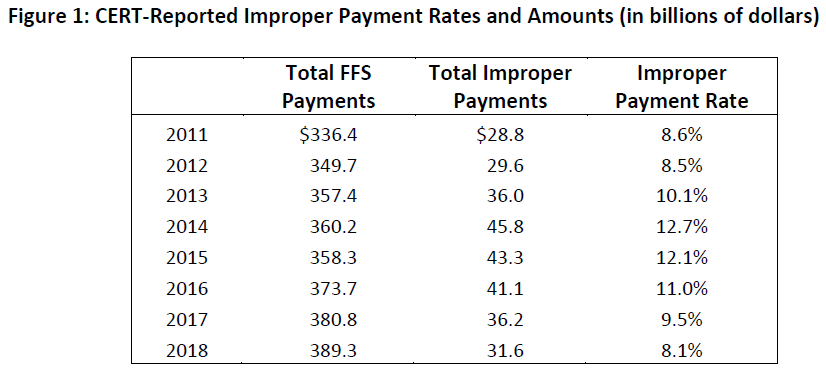
In 2017, OIG began an audit to determine if CMS was using the CERT data to identify and focus on what it called error-prone providers. (Remember that OIG first pointed out this issue in 2010.) In the most recent audit, which concluded in June 2020, OIG reviewed the steps CMS took to reduce improper payment rates for reporting years 2014 through 2017, the four highest years between 2011 and 2018. (See Figure 1 below from the OIG’s report.)

How does CMS’s CERT Program Work?

In a nutshell, CMS’s statistical contractor develops a statistical sample for the year’s CERT program activities which then pass to CMS’s medical review contractors.  These individuals evaluate medical record documentation to determine whether claims were paid properly under Medicare’s coverage, coding and billing rules.  The statistical contractor uses the medical review contractor’s determinations to estimate the rate of improper payments, called CERT data.

CMS monitors this information and launches initiatives, carried out by Medicare administrative contractors (MACs), such as pre-payment and post-payment claim review, education and TPE activities.  Pre-payment reviews occur when the MAC makes a determination before the claim is paid, and post-payment reviews are done after the claim has been paid.  When a claim is denied after post-payment review, the MAC provides details to the provider, explaining the error(s) in the original claim, in an effort to  remediate faulty behavior.

Educational programs are multi-faceted:  articles, webinars and meetings, coding instructions and coverage determinations focus on proper coding and processes to submit claims as well as coverage guidelines and the circumstances that support medical necessity for services.

TPE activities through the Targeted Probe & Educate (TPE) Program include one-on-one education to providers with high denial rates or unusual billing practices to assist in reducing claim errors and denials. Follow-up reviews are conducted to check on improvements or changes.

Back to the OIG’s Audit Findings

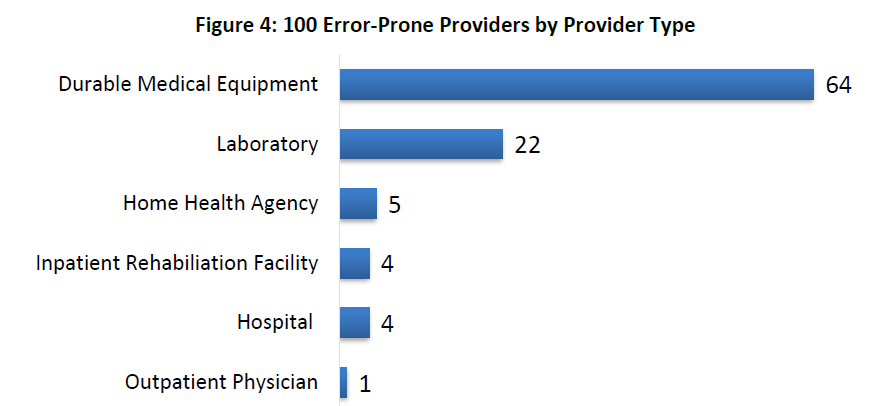
OIG identified 100 error prone providers who received $3.5 million in overpayments out of the $5.8 million reviewed by CERT, which represents a 60.7% error rate – much higher than the national average of 11.3% for all Medicare providers from 2014 through 2017.  Although CMS provided contractors with a list of error-prone providers, it did not instruct the contractors on how to use the list. Moreover, the list did not include details needed by the contractors to readily determine which providers fell in their jurisdiction.  CMS discontinued providing CERT data to contractors because it determined the CERT data was “ineffective” for this purpose.

Instead, CMS focused its efforts to reduce improper payments on certain types of services, namely home health (HHA), inpatient rehabilitation (IRF) and skilled nursing (SNF), for which corrective actions would presumably have the biggest impact on the overall error rate. The OIG, however, drilled down on its list of the top-100 error prone providers and found that only nine fell in CMS’s focus area. Figure 4, below, from the OIG report, shows the composition of providers in the top-100 list. Keep in mind that CMS targeted home health, inpatient rehabilitation and skilled nursing facilities for remediation efforts.

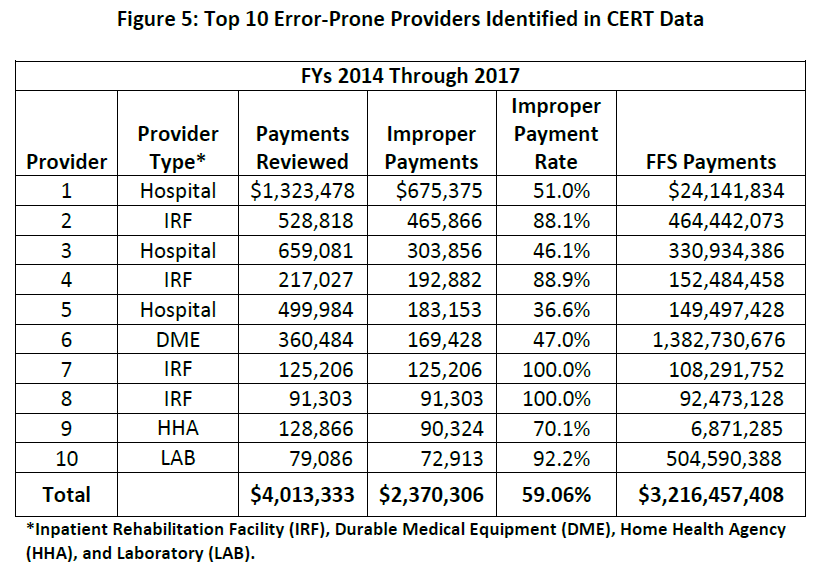
OIG then reviewed the top 10 error-prone providers by dollar amount and determined that their overpayments totaled $2.4 million, 60% of the $4.0 million reviewed by CERT.  See Figure 5 below from the OIG report.

The OIG report summarized information for one provider whose error rate was 92% on a sample of 3,000 claims, and stated that errors were consistently high for each of the four years reviewed.  OIG concluded that the magnitude and consistency of errors, along with the number of claims reviewed in the sample, provide “substantial evidence” that a large majority of the $500 million in FFS payments made to this provider between 2014 and 2017 were improper.   And finally, OIG conducted simulation testing to confirm that the providers it identified were statistically more likely to submit improper claims than the average provider.

It would appear that, as OIG recommended in 2010 and in 2021, CERT data is somewhat useful in identifying providers who merit additional scrutiny.  CMS disagreed, citing issues with the methodology used by the OIG and its conclusions.  In the volley of comments between the two entities, OIG stressed that it was not suggesting CMS use CERT data exclusively or to discontinue using other tools that have proven beneficial in recouping improper payments. OIG was instead recommending that CMS add CERT data to its arsenal and give the appropriate value to the government’s investment in the CERT program, which has yielded important information that may preserve the Medicare Trust Funds.

Read Full Post | Comments Off on OIG Says CMS Misses the Forest for the Trees

Tagged , , , , , |

Review Exempt Employees to Assure Compliance with Revised Rules

As businesses begin a new year and HR professionals ensure that all regulatory compliance is in place, now is a good time to review overtime exemption rules. This area continues to be the basis for the greatest number of lawsuits filed in the United States and one of the costliest from which to recover. Employers are often shocked at the impact of one employee complaint to the Department of Labor (DOL) which can result in a DOL audit, and usually encompass a two-year review of all payroll records.

On September 24, 2019, with an effective date of January 1, 2020, the DOL released a final overtime rule which set the minimum salary for the exemption of overtime pay under the Fair Labor Standards Act (FLSA). The salary threshold for this exemption was raised from $23,660 to $35,568 a year. This was the first increase since 2004 and was a more moderate increase from the proposed $47,476 that was on the table in 2016. It is important to note that the final rule allows employers to use non-discretionary bonuses and incentive payments (including commissions), that are paid out to satisfy up to 10 percent of the salary level. The DOL estimated that approximately 1.3 million workers would become eligible for overtime pay and that the rule would significantly benefit workers in multiple industries such as health services, wholesale and retail, education, hospitality and manufacturing.

Here are some key components that HR professionals need to know:

  • Employees paid less than $35,568 a year or $684 weekly are entitled to overtime pay regardless of their classification as a manager or professional.
  • The final rule allows employers to use paid non-discretionary bonuses and incentive payments (including commissions) to satisfy up to 10 percent of the salary level.
  • It is important to still follow the exempt/non-exempt rules as there were no changes to the duties test. Clarification on these rules can be found on the DOL’s website. https://www.dol.gov/agencies/whd/fact-sheets/17a-overtime
  • The annual minimum compensation for “highly compensated employees” was increased from $100,000 to $107,432.

Given the new thresholds of this final rule, it is important to take steps to ensure that any exempt employees do not lose their status.  Consider increasing their salaries or providing other compensation that would maintain their salary levels above the threshold for exempt status. Also, in general, it’s a good idea to examine all payroll practices to make sure that all employees are properly classified.


Read Full Post | Comments Off on Review Exempt Employees to Assure Compliance with Revised Rules

Tagged , , , , , |

What We’re Reading – CDC Releases Updated Coding Guidelines

A recent article summarized updated ICD-10-CM coding guidelines for COVID-19 and vaping disorders.  Here are some bullet points to keep in mind:

  • For confirmed COVID cases, use U07.1, with documentation supporting the diagnosis.  A positive test result is not required.
  • For possible, probably or likely cases of COVID, code the presenting symptoms.
  • Sequencing of codes for a COVID patient requires coding COVID (U07.1) as the principal diagnosis and manifestations as secondary, unless the manifestation code instructs otherwise. For example, Pneumonia and COVID are coded U07.1 & J12.82.  Bronchitis and COVID are coded U07.1 & J40.
  • For non-respiratory manifestations, the same coding convention applies:  U07.1 as primary and the manifestation as secondary.
  • Code an asymptomatic patient exposed to actual or suspected COVID as Z20.822.
  • When testing a patient exposed to COVID, use Z20.822 and not Z11.52.
  • Patients with personal history of COVID are coded as Z86.16,  If the patient comes in for follow-up after a resolved bout of COVID, use Z09 & Z86.16.

Vaping disorders had less updates.  For conditions related to vaping, assign U07.0 and code any resulting manifestations.  Codes for vaping-related respiratory signs and symptoms are not coded separately once a definitive diagnosis has been made.

Read Full Post | Comments Off on What We’re Reading – CDC Releases Updated Coding Guidelines

Tagged , , , |

The ABCs of Coding

Imagine trying to have a conversation with someone who only speaks a foreign language and having no access to a translator.  Tough to do, right?  You’d need basic use and understanding of relevant words in the foreign language and your new friend would need the same for your language. Only then can you interact more meaningfully, with confidence that you’re both referring to the same things, referencing words in your own language to which you know the meaning.  Welcome to medical coding!  This is how the healthcare world removes as much ambiguity as possible and assures that all parties better understand the nuances of disease, procedures and even test results.

The most common coding systems are:

  1. ICD-10, or International Statistical Classification of Diseases and Related Health Problems, 10th Revision.  ICD-10-CM (CM for Clinical Modification) is the version of ICD-10 used in the US.  The codes in ICD-10-CM convey medical diagnoses and other information, such as associated conditions or manifestations, and even location and manner of an accident, for example. The codes are used for communication among the healthcare community as well as for research, billing and mortality statistics.

ICD-10-CM codes are alpha-numeric and up to seven characters in length.  They are arranged in 22 chapters that correspond to specific disorders, organ systems, symptoms and other factors.  ICD-10-CM contains over 72,000 codes that range from general or unspecified codes, meaning that little precision is documented or known, to very specific codes that convey nuances of the medical condition and related or causative elements.   They are updated at least once per year in October but changes may also take effect in April.

ICD-10-CM codes help to communicate the complexity of a patient’s health status and, along with the provider’s documentation, assist in justifying medical necessity.

  1. CPT, or Current Procedural Terminology, is a set of codes used to identify procedures and services, and although there are three categories of CPT codes, Categories 1 and 2 are the most common in healthcare settings.

Category 1 CPT codes contain the majority of procedure codes from an office visit with your doctor or other healthcare practitioner, to surgeries, delivering a baby and associated activities, such as anesthesia, venipuncture and imaging services.  Category 2 CPT codes are used for reporting and tracking healthcare outcomes and quality measures, such as your blood pressure readings, medication review post-hospital discharge, exposure to second-hand smoke and use of specific medications for certain conditions.

Many payors have implemented performance management systems that incentivize providers: to report Cat 2 codes; to achieve particular outcomes that contribute to wellness, lower healthcare costs and reduce probability of complications, such as diabetes control; and to perform wellness activities, such as screenings, that may or may not carry additional payment.

There are over 10,000 CPT codes, each five numeric-only or alphanumeric characters long, and they are updated annually in November for a January 1 effective date.  Medical necessity is synthesized by the provider into the selection of some CPT codes. To help distinguish between ICD-10 and CPT, think “D” for diseases and “P” for procedures!

  1. The less well-known SNOMED CT, or Systematized Nomenclature of Medicine – Clinical Terms, is used more internationally and conveys a great deal more information in its codes, preferred especially in research settings.

There are over 350,000 SNOMED CT codes, or identifiers, that are described as unambiguous and devoid of “any ascribed human interpretable meaning.”  At the core of SNOMED CT are concepts, descriptions and relationships.  SNOMED CT takes into consideration clinical findings, body structure, organisms, procedures, causative elements, qualifying characteristics, even social contexts, plus relationships or hierarchies in a single code!

These codes are continuously updated but revised codes are released on January 31 and July 31 of each year.

Medical coding can seem like a lot of alphabet soup.  But when you consider that providers need to communicate with each other and with payors, and to report medical data that will be understood by all parties, including other countries, you can see the critical need for universality of language.

Read Full Post | Comments Off on The ABCs of Coding

Tagged , , , |

What We’re Reading – New coding guidelines a recipe for improved revenue

As we close the first week of the new E/M coding guidelines – assuming your brain spasms are resolving – you might be wondering how the changes line up to payments.  Are you better or worse off under the new coding requirements?  According to this article, you’re better, so hang in there!  The author uses the case of a single worsening chronic problem, which would have required low-level decision-making, or Level 3, in 2020.

Under the 2021 coding guidelines, it moves to moderate decision-making or Level 4 because “all your worsening, exacerbated, poorly controlled, uncontrolled, inadequate response to treatment and the new label ‘not at goal,’ will most often result in an adjustment to medications either in dosage or a change in regimen.”  So while in 2020, a Level 4 visit would require one stable and one worse assessed condition, 2021 requires only one with a medication change.

In addition, a ‘severe worsening or exacerbated’ problem that involves ‘a decision regarding hospitalization’ – which would have been a Level 4 visit in 2020 – now qualifies for Level 5.  As the author concludes, the MDM tables in 2021 seem to result in higher visit levels and associated payments without doing anything differently, a win-win!

To read more about the specific changes in E/M coding for 2021, click here.

Read Full Post | Comments Off on What We’re Reading – New coding guidelines a recipe for improved revenue

Tagged , , , , , |

“Webside Manner” 101

Before the pandemic, we always referred to bedside manner but after COVID and telehealth (TH) were approved during the Public Health Emergency (PHE), this is being referred to “webside manner,” an indication of the changing times. Not only is TH new for patients but it might also be new to providers because before the PHE, it was only used in rural areas. The expansion of TH means clinicians have to shift from providing care during an in-person visit to a virtual visit. This article gives good advice on how to keep your patients’ overall visits feeling as if they are face-to-face even though they’re technology-assisted.

Here are five TH tips to keep patients happy and committed to your practice:

  1. Start with an orientation. Since telehealth is new to the provider and probably the patient as well, it’s good to start with an explanation of how the system works. If using audio only, make sure you can hear each other clearly; for video calls, make sure you can see and hear each other, and explain what to do in case of a hiccup or failure in the connection. Remind the patient to be as descriptive as possible about symptoms, especially because no physical exam can be performed. Explain that a TH visit is like a face-to-face visit in that everything discussed is confidential.
  1. Set the scene. Make sure your office is well-lit and organized, and that you are dressed as you would for an in-person visit (e.g., lab coat) so your patient feels comfortable and trusting. Also, make sure to minimize distractions for you and your patient so everyone has good concentration on the medical issues discussed.
  1. Look your patient in the “eyes”. This might be more complicated and require adjusting your camera or body positioning, but it’s important to make sure you have eye contact so the patient feels your engagement. Make sure all the electronic health record (EHR) information is ready before the appointment so you can easily access the patient’s chart and you can maintain interaction with the patient. If possible, show the patient her lab results or x-rays during your discussion so she has a total “doctor’s appointment” experience. Remember that the absence of a physical exam means you will be asking more questions; build them into the conversation so it resembles a dialogue and not an inquisition.
  1. Amp up signs of empathy. Make sure you let the patient complete his sentences and avoid interrupting his explanations. Use visual cues to let him know you are paying attention and listening to his opinions, making sure to reiterate or paraphrase important statements to show you’re both on the same page. Another crucial tip is starting the appointment on time; we understand emergencies happen and prior visits can be longer than expected, but at least have a staff member inform the patient if you are running late.
  1. Lean on what’s familiar and easy. Try to make the virtual visit experience feel as much as possible like a face-to-face appointment. The activities should be parallel, such as reminding of an upcoming appointment, or at the time of the visit, implementing a pre-check-in process, even a virtual waiting room, and of course, letting the patient know if you’re running behind schedule. It’s important to make the TH visit as seamless a process as possible.

At the end of this PHE, TH visits will probably be permanent and we will all have to adapt to this new way of doing things.  Consider surveying your patients after a TH visit has been completed to learn how they felt about the TH experience and any suggestions to make it better. You want your “webside manner” to be as good as your “bedside manner!”

Read Full Post | Comments Off on “Webside Manner” 101

Tagged , , , |

FLSA Changes to Worker Classifications Effective March 8th

In November, we summarized the proposed changes to the Fair Labor Standards Act and the guidelines for classifying individuals as employees or independent contractors (IC).  The Final Rule was just released and will be effective on March 8, 2021.  Here is a link to the original blog with explanations of the changes.

The Final Rule:

  • Reaffirms the “economic reality” test to determine whether an individual is in business for him or herself (independent contractor) or is economically dependent on a potential employer for work (FLSA employee).
  • Identifies and explains two “core factors” that are most probative to the question of whether a worker is economically dependent on someone else’s business or is in business for him or herself:
    • The nature and degree of control over the work.
    • The worker’s opportunity for profit or loss based on initiative and/or investment.
  • Identifies three other factors that may serve as additional guideposts in the analysis, particularly when the two core factors do not point to the same classification. The factors are:
    • The amount of skill required for the work.
    • The degree of permanence of the working relationship between the worker and the potential employer.
    • Whether the work is part of an integrated unit of production.
  • Gives importance to the actual practice of the worker and the potential employer, which is more relevant than what may be contractually or theoretically possible.
  • Provides six fact-specific examples applying the factors.

Read Full Post | Comments Off on FLSA Changes to Worker Classifications Effective March 8th

The APD Provider Business Model

The Agency for Persons with Disabilities (APD) is a Florida agency that administers a Medicaid Waiver Program through the Home and Community-Based Services waiver to the general Medicaid requirements. APD pays providers for services to persons with disabilities through the Florida Medicaid Program according to an established fee schedule.  Recipients, as they’re called, can receive services ranging from personal care and companion to skilled care (nursing, therapies), dieticians and even environmental accommodations!  The services are managed by a Waiver Support Coordinator, who assigns recipients to providers and manages communications regarding the services that have been approved for each individual.

The idea behind this waiver program (and really, all of them) is to provide person-centered and individualized assistance in the home to avoid the recipient’s institutionalization.  The good news for providers is that there are fewer requirements than those for licensing as a home health agency (HHA) or nurse registry (NR). However, all care is limited to APD recipients through the APD Waiver Program and as assigned by APD.  It’s important to note that HHAs and NRs cannot serve this population without approval as APD providers and specific policies & procedures as required by APD.

The process to establish an APD Provider may take significantly less time than for an HHA or an NR, depending on the number and types of services the client intends to provide.

Read Full Post | Comments Off on The APD Provider Business Model

Tagged , , , , , |